
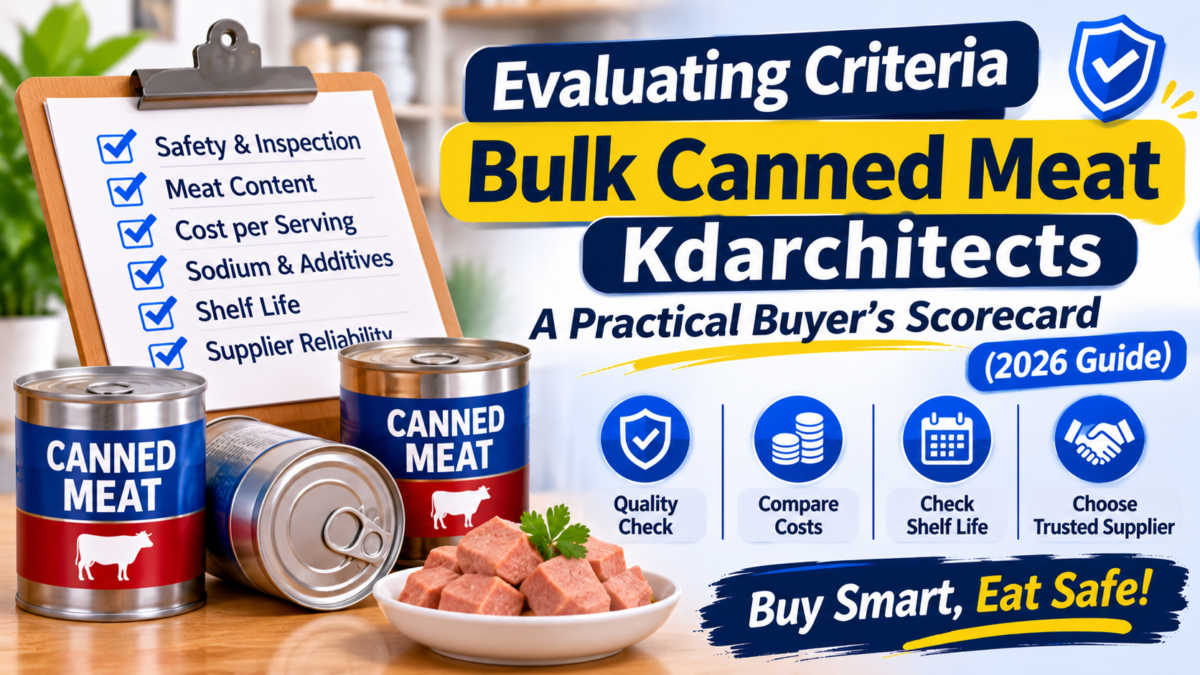
A pallet of canned meat is a large commitment. If you pick the wrong product, you could be stuck with hundreds of cans that taste bad, carry too much sodium, or cost more per serving than the case price suggested. This guide lays out the evaluating criteria bulk canned meat kdarchitects buyers should use before placing an order. It works for a household stockpile, a restaurant kitchen, a church pantry, or an emergency supply closet.
Most bulk-meat advice online is written for fresh or frozen cuts. It tells you to “buy from a reputable source” and look for “grass-fed” labels, which does little for a shelf-stable product sealed in a steel can. Canned meat has its own rules: what the label really says, how the product is sterilized, how it’s inspected, and how to compare real costs.
Why Canned Meat Needs Its Own Evaluation Framework
Fresh meat is judged by color, smell and texture. Canned meat hides all of that behind metal. You can’t squeeze it or sniff it before you buy, so you have to rely on labels, inspection marks, supplier records and a few quick checks on the can itself.
Canned meat is also a low-acid food, so it is processed under heat and pressure to reach commercial sterility, meaning the product is free of organisms that could grow in storage. That is why it can sit on a shelf for years, and why a damaged can is a real safety issue rather than a cosmetic one.
Three things make bulk buying riskier than a single-can purchase:
- Scale: one bad lot affects every can in the order.
- Storage: you will hold the product for months or years, so rotation and conditions matter.
- Limited returns: many wholesalers won’t take back opened or stored inventory.
How the Evaluating Criteria Bulk Canned Meat Kdarchitects Scorecard Works
The scorecard below turns the decision into numbers. Score each product from 1 to 5 on each criterion, multiply by the weight, and add up the total. Adjust the weights to fit your situation. A food bank might weight sodium and cost heavily, while a prepper might weight shelf life first.
| Criterion | What to check | Default weight |
|---|---|---|
| Safety and inspection | USDA mark of inspection, recall history, can condition | 25% |
| Meat content | Meat percentage, ingredient order, fillers | 20% |
| Cost per serving and per gram of protein | Real price after shipping and tax | 20% |
| Sodium and additives | Milligrams per serving, nitrates, phosphates | 15% |
| Shelf life and storage fit | Date code, storage conditions, case size | 10% |
| Supplier reliability | Minimum order, return policy, lot traceability | 10% |
Anything scoring below 3 on safety should be disqualified outright, no matter how cheap it is. A low price never makes up for a weak safety record.
Criterion 1: Safety and Inspection
Check for the USDA mark of inspection
Meat and poultry products sold in the US are generally inspected by the USDA’s Food Safety and Inspection Service (FSIS). Look for the round mark of inspection with an establishment number on the label. Seafood is mostly regulated by the FDA, so canned tuna and salmon follow a different system.
If a supplier can’t tell you which plant produced the product, treat that as a red flag. A legitimate wholesaler can give you the establishment number and the lot code.
Look up recall history
Before buying, search the FSIS recall page for the brand and the plant number. A past recall doesn’t automatically rule out a producer, but you should know how they responded and whether the problem was fixed. Ask your supplier whether any product in your lot has been affected by a recall.
Inspect the cans themselves
Whenever you receive a delivery, open a few cases and check every can in the sample. Reject the shipment, or at least the affected cans, if you see any of these:
- Bulging or swollen ends
- Leaking seams or crusted residue near the seam
- Deep dents on the seam or rim
- Heavy rust that pits the metal
- Spurting liquid or a foul smell when opened
A bulging can can indicate bacterial growth, including the organism that causes botulism. Don’t taste it, and dispose of it safely.
Criterion 2: Meat Content and Label Reading
Read the ingredient list from the top
Ingredients are listed by weight. A good canned chicken product lists chicken first, followed by water or broth and salt. If water, starch or a long list of binders appear early, you are paying meat prices for filler.
Know what the numbers mean
| Label item | What it tells you | What to watch for |
|---|---|---|
| Net weight | Total contents, including liquid | Don’t compare cans by net weight alone |
| Serving size and servings per can | Basis for all nutrition numbers | Some cans list two or more servings, which hides sodium per can |
| Protein per serving | Nutritional value for the money | Compare on a per-ounce or per-gram basis |
| “Product of USA” | Origin claim | Under FSIS rules in effect as of 2026, the voluntary claim has stricter requirements than it used to |
| Meat percentage | Share of actual meat | Not always listed, so ask the supplier for a spec sheet |
Compare product types fairly
Different meats serve different purposes. Chicken breast chunks work for salads and casseroles. Spiced or luncheon-style meats are cheaper but usually carry more sodium and more additives. Corned beef, chili and stew products have their own cost and nutrition profiles.
| Product type | Typical strengths | Typical trade-offs |
|---|---|---|
| Canned chicken | Lean, flexible in recipes | Can be dry or watery |
| Canned beef or roast beef | Strong flavor, good in stews | Usually higher cost per ounce |
| Corned beef | Familiar, ready to eat | Higher sodium and fat |
| Spiced or luncheon meat | Low price, long storage | Highest sodium, more additives |
| Canned tuna and salmon | High protein, FDA-regulated | Price swings, mercury guidance for frequent eaters |
Criterion 3: Real Cost Per Serving and Per Gram of Protein
Case price is the least useful number on a quote. What matters is what you pay for usable protein once everything is counted.
Use this formula
- Add the case price, shipping, and any tax or fees.
- Divide by the number of cans to get cost per can.
- Divide by the number of servings per can to get cost per serving.
- Divide cost per serving by grams of protein per serving to get cost per gram of protein.
Worked example (illustrative numbers)
These numbers are made up to show the method. Use the actual prices and labels from your own quotes.
| Product A | Product B | |
|---|---|---|
| Case price (24 cans) | $48.00 | $38.40 |
| Shipping | $12.00 | $0.00 |
| Total cost | $60.00 | $38.40 |
| Cost per can | $2.50 | $1.60 |
| Servings per can | 2 | 2 |
| Cost per serving | $1.25 | $0.80 |
| Protein per serving | 12 g | 7 g |
| Cost per gram of protein | about $0.104 | about $0.114 |
Product B looks much cheaper per can and per serving. Once you account for protein, the gap shrinks and Product A comes out ahead. If Product B also has more sodium or more filler, Product A is the better buy. This is the kind of comparison the evaluating criteria bulk canned meat kdarchitects approach is meant to force.
Watch for hidden costs
- Freight and pallet fees: heavy cases add up quickly.
- Minimum orders: a low unit price may require a volume you can’t store.
- Waste: cans that expire unused have an effective cost of zero value.
Criterion 4: Sodium and Additives
Canned meat is often high in sodium because salt acts as a preservative and flavor enhancer. The FDA’s daily value for sodium is 2,300 milligrams, so a single serving that delivers a large share of that matters if you eat canned meat regularly.
What to compare
- Sodium per serving and per can: multiply if the can holds more than one serving.
- Reduced-sodium versions: these exist for several chicken and tuna products.
- Added nitrates or nitrites: common in cured products like corned beef and luncheon meat.
- Phosphates and binders: often used to hold moisture in chunked or formed products.
- Can lining: many manufacturers now advertise BPA-free linings. If this matters to you, ask for documentation rather than relying on a marketing line.
For institutional buyers serving people with high blood pressure or kidney concerns, sodium should carry more weight in your scorecard than price.
Criterion 5: Shelf Life and Storage
Understand date codes
Most canned meat carries a “best by” or code date. It reflects peak quality, not an exact safety cutoff. USDA guidance generally says low-acid canned goods like meat keep their best quality for a few years when stored properly, but you should still inspect each can before use.
Some manufacturers print a coded date that is not easy to read. Ask your supplier for the code key so you can rotate stock correctly.
Store it right
| Storage factor | Target | Why it matters |
|---|---|---|
| Temperature | Cool and steady, ideally below about 85°F | Heat shortens quality life |
| Humidity | Dry | Prevents rust on cans |
| Location | Off the floor, away from exterior walls and water heaters | Avoids moisture and temperature swings |
| Rotation | First in, first out | Keeps old stock from being forgotten |
Build a simple rotation system
- Write the date received on each case with a marker.
- Place new cases behind or beneath older ones.
- Check the front of each shelf monthly.
- Use the oldest cans for everyday meals and keep newer ones as reserve.
Criterion 6: Supplier Reliability
A product can score well on paper and still arrive wrong. Evaluate the seller as carefully as the can.
Questions to ask before ordering
- Which plant produced this lot, and what is the establishment number?
- Can you provide a spec sheet with ingredients, meat content and nutrition data?
- What are the lot codes and date codes on the pallet being shipped?
- What is your policy on damaged or bulging cans at delivery?
- Is there a minimum order, and does it include freight?
- Can I buy a single case first as a test?
Where bulk canned meat is commonly sourced
| Source | Best for | Watch for |
|---|---|---|
| Warehouse clubs | Households and small groups | Limited variety, membership fees |
| Restaurant supply stores | Kitchens and small organizations | Case sizes larger than needed |
| Foodservice distributors | Restaurants and institutions | Minimums and delivery schedules |
| Direct from manufacturers | Large, repeat buyers | Large volumes and freight |
| Online wholesalers | Convenience | Shipping damage, unclear sourcing |
Order a single test case from any new supplier. Check can condition, open a few, taste the product, and score it with your own sheet before committing to a pallet.
Matching the Criteria to Your Situation
The evaluating criteria bulk canned meat kdarchitects scorecard changes depending on who is buying. Adjust the weights rather than ignoring criteria.
Household and emergency stockpiles
Prioritize shelf life, safety and storage fit. Buy in amounts you can rotate through within a few years, and favor products your family already eats. A stockpile of food nobody likes tends to get wasted.
Restaurants and catering
Prioritize consistency and cost per usable serving. Test how the product performs in your recipes, since texture and moisture vary a lot between brands. Ask for spec sheets so you can keep the same product on your menu.
Food banks and nonprofits
Prioritize sodium, cost per gram of protein, and simple, recognizable products. Consider the dietary needs of the people you serve, and check donated cans carefully for damage and date codes.
Institutional procurement
Federal buyers use detailed specifications and sample testing before accepting a supplier. For example, the USDA requires producers to submit product samples and documentation for evaluation before they can bid on canned meat purchases. You can borrow that approach on a smaller scale: request samples, document your criteria, and score every bidder the same way.
A Simple Pre-Purchase Checklist
Print this and use it for every new order:
- Confirm the USDA mark of inspection and the establishment number.
- Search FSIS recalls for the brand and plant.
- Get a spec sheet with ingredients and nutrition.
- Calculate cost per serving and per gram of protein, including freight.
- Compare sodium per serving and per can.
- Check the code date and ask how to read it.
- Order one test case before a full pallet.
- Inspect cans on arrival and record any damage.
- Label cases with the received date and set up first in, first out rotation.
- Score each option with the weighted table.
Common Mistakes to Avoid
- Buying on case price alone: cheaper cans often have less meat per ounce.
- Skipping the test case: taste and texture differ more than people expect.
- Ignoring sodium: it adds up fast when canned meat becomes a regular meal.
- Poor storage: a hot garage can shorten quality life, and a damp basement can rust cans.
- Not rotating: a large stockpile without a rotation plan eventually becomes waste.
- Accepting damaged cans: a bulging can is a safety issue, not a bargain.
Frequently Asked Questions
How long does bulk canned meat last?
Properly stored canned meat typically stays at good quality for several years, but always check the code date and inspect each can before eating.
Is it safe to eat canned meat past its best-by date?
Often yes if the can is intact and the product looks and smells normal, but quality declines over time. Discard any can that is bulging, leaking or smells off.
What does the USDA mark of inspection mean on canned meat?
It shows that the product was made in a plant inspected by FSIS. The establishment number lets you trace the producer.
Is canned chicken or canned beef a better value?
It depends on the protein per serving and the price, so compare cost per gram of protein rather than price per can.
How do I check for recalls?
Search the FSIS recall list using the brand name and establishment number.
What is the best way to store canned meat in bulk?
Keep it in a cool, dry place off the floor, and rotate stock with a first in, first out system.
Should I buy a full pallet right away?
No. Order a single test case first, then scale up once you’ve checked quality, taste and the supplier’s reliability.
Final Thoughts
Bulk canned meat can be a smart, affordable way to feed a household or an organization, but only if you evaluate it carefully. The evaluating criteria bulk canned meat kdarchitects scorecard gives you a repeatable way to compare products: safety first, then meat content, real cost, sodium, shelf life and supplier reliability.
Treat every new product as a test. Score it, sample it, and calculate its real cost before you buy in volume. Use the evaluating criteria bulk canned meat kdarchitects checklist every time you reorder, and you’ll spend less, waste less and avoid the mistakes that make bulk buying expensive.
