

Choosing a pex plumbing type kdarchitects plumbing piping plan comes down to three decisions: which PEX grade you buy, how you route it, and which fitting system joins it. Most guides stop at “PEX is flexible and cheaper than copper.” That is true, but it doesn’t help you write a spec or price a job. A tube that suits a repipe through finished walls may be wrong for a radiant slab. A layout that saves labor can raise tubing cost. A fitting that installs in seconds can restrict flow.
This guide follows the order the decisions come up on a real project: material grade, application, layout, fittings, code, installation details, and cost.
What PEX Actually Is
PEX is cross-linked polyethylene. Manufacturers start with high-density polyethylene and chemically or physically bond the polymer chains together. That cross-linking lets the tube handle hot water, hold pressure, and flex without cracking. It also gives PEX its “memory,” meaning it tries to return to its original shape after bending or stretching.
PEX is used for:
- Potable hot and cold water supply lines kdarchistyle building types from kdarchitects
- Hydronic heating loops
- Radiant floor heating
- Fire sprinkler systems in some approved applications
PEX is not a drain, waste, or vent material. Those lines are still PVC, ABS, or cast iron. Readers who ask whether PEX or PVC is better are comparing pipes that do different jobs: PEX moves pressurized supply water, while PVC carries gravity drainage.
Any pex plumbing type kdarchitects plumbing piping discussion should start with these basic ratings, which apply to most PEX tubing sold in the US:
- 160 psi at 73°F
- 100 psi at 180°F
- 80 psi at 200°F
- Common residential sizes: 3/8, 1/2, 3/4, and 1 inch
One detail catches designers off guard. PEX has a smaller inside diameter than copper of the same nominal size. A 1/2-inch PEX line delivers less flow than a 1/2-inch copper line, so sizing tables and fixture unit counts matter more than they did with copper.
The Three PEX Types Compared

The A, B, and C labels describe how the tubing is cross-linked, not a quality ranking. The method affects flexibility, kink repair, and which fittings you can use.
| Feature | PEX-A | PEX-B | PEX-C |
|---|---|---|---|
| Cross-linking method | Peroxide (Engel), during extrusion | Silane, moisture-cured after extrusion | Electron beam irradiation after extrusion |
| Flexibility | Highest | Medium | Lowest of the three |
| Kink repair | Heat gun restores the tube | Cut out the kink | Cut out the kink |
| Fitting options | Expansion, crimp, clamp, push-fit | Crimp, clamp, push-fit | Crimp, clamp, push-fit |
| Relative material cost | Higher | Lower | Varies by brand |
| Common choice for | Repipes, tight routing, cold climates | Large new-build runs | Smaller retail-scale jobs |
PEX-A
PEX-A is cross-linked while the tube is being extruded, which produces the most uniform molecular structure of the three. In practice this means three things:
- It bends tightly with less force, which helps when fishing lines through existing framing.
- A kink can be repaired by heating the tube with a heat gun until it returns to shape.
- It is the only type that works with cold-expansion fittings, which leave a full-bore waterway.
The trade-off is price. PEX-A usually costs more per foot than PEX-B.
PEX-B
PEX-B is cross-linked after extrusion using silane, with moisture curing the bonds. It is stiffer than PEX-A and stays straighter on long runs, which some installers prefer for clean horizontal lines in basements and open framing. It is widely stocked and is the usual choice when budget drives the decision. A kink must be cut out and replaced with a coupling, so careful handling matters.
PEX-C
PEX-C is cross-linked by electron beam irradiation after the tube is made. It sits at the stiff end of the range and is less common in professional supply channels than A or B. It works with crimp and clamp fittings and performs well in standard supply applications. If a spec calls for PEX-C, confirm availability of the tubing and fittings for your region before you commit.
PEX-AL-PEX and Oxygen Barrier Tubing
Two related products are often confused with the three standard types:
- PEX-AL-PEX sandwiches an aluminum layer between two PEX layers. It holds its shape when bent, expands and contracts very little with temperature, and blocks oxygen. It is common in hydronic heating, larger-diameter supply lines, and exposed runs where straight, neat routing matters.
- Oxygen barrier PEX carries a thin barrier layer, usually EVOH, on the outside of standard PEX. It is used in heating loops connected to iron or steel components, because oxygen entering through the tube wall corrodes those parts.
Neither product is a fourth grade of PEX. Both are specified for particular jobs.
Matching the Tubing to the Job
The most useful question is not “which type is best” but “which type fits this scenario.”
| Scenario | Suggested Tubing | Reason |
|---|---|---|
| Repipe through finished walls | PEX-A | Tight bends, easy to fish, kinks can be repaired |
| New build with long straight runs | PEX-B | Lower material cost, holds straight lines |
| Radiant floor heating | Oxygen barrier PEX-A or PEX-B | Protects iron and steel components from corrosion |
| Exposed mechanical room runs | PEX-AL-PEX | Holds shape, low expansion, neat appearance |
| Unheated or cold-climate spaces | PEX-A, insulated | Tolerates freeze expansion better, but still needs insulation |
| Large commercial distribution | PEX-A or PEX-AL-PEX per engineer spec | Larger diameters and fitting options |
PEX tolerates freezing better than copper because it expands instead of splitting. It is still not freeze-proof. Fittings can fail, and a frozen line is still a frozen line. Insulation and heated space remain the real protection.
Choosing a Piping Layout
Once the tubing is chosen, the layout controls tubing length, fitting count, and hot water delivery time. A pex plumbing type kdarchitects plumbing piping plan should state the layout in the drawings, not leave it to the installer’s habit.
Trunk and Branch
A trunk and branch system works like traditional copper plumbing. A large main line (the trunk) runs through the building, and smaller lines (branches) split off to groups of fixtures, with a tee at each connection.
- Fewer total feet of tubing
- More fittings, and each one is a potential leak point
- Works well in compact homes with fixtures close together
Home-Run Manifold
In a home-run system, every fixture gets its own dedicated line from a central manifold. The manifold works like a breaker panel for water.
- One continuous tube from manifold to fixture, with no fittings hidden in walls
- Individual shutoffs per fixture or zone
- Smaller diameter lines, such as 3/8-inch to lavatories
- More total tubing and a larger manifold investment
Hybrid Layouts
Hybrid systems use a trunk line for the main run and a manifold or home-run lines for bathroom groups or distant fixtures. This approach often balances tubing cost, labor, and performance, especially in larger homes.
| Layout | Tubing Length | Hidden Fittings | Fixture Isolation | Best Fit |
|---|---|---|---|---|
| Trunk and branch | Shorter | More | Limited | Small homes, tight budgets |
| Home-run manifold | Longer | Fewest | Individual | Custom homes, service access priority |
| Hybrid | Moderate | Moderate | Zone-level | Larger homes, multi-bath layouts |
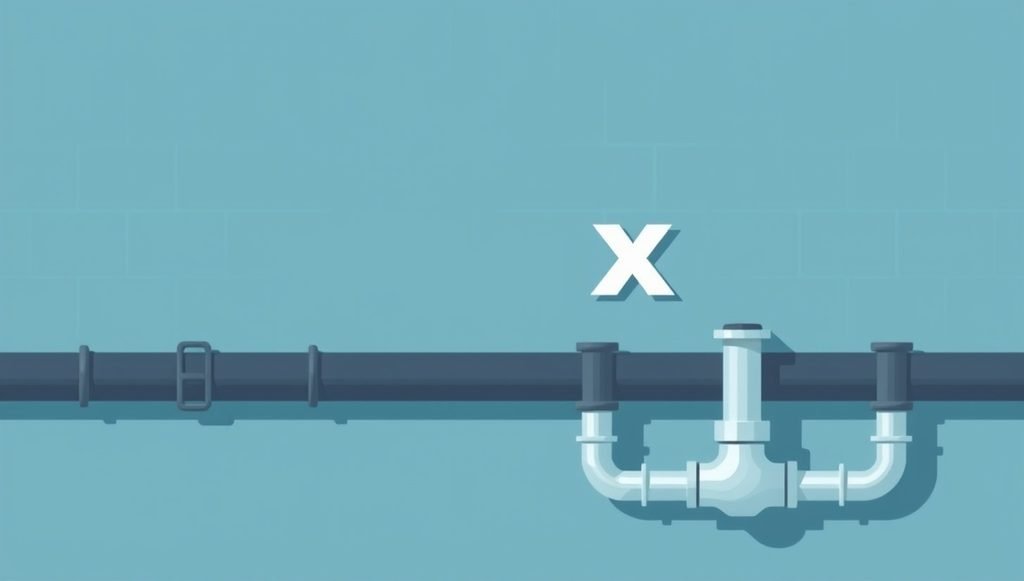
Hot water wait time depends on line volume between the heater and the fixture. Small-diameter home-run lines can shorten the wait at individual fixtures, but a long run to a distant manifold can cancel that gain. Place the manifold and water heater with the wet rooms in mind.
Fitting Systems: How PEX Gets Joined
The fitting system affects flow, tool cost, installation speed, and long-term reliability. It also limits which PEX grades you can use.
| Method | Works With | Tool Needed | Key Points |
|---|---|---|---|
| Crimp ring (copper) | A, B, C | Crimp tool and go/no-go gauge | Widely used, gauge check confirms each joint |
| Clamp ring (stainless) | A, B, C | Cinch tool | One tool covers multiple sizes |
| Cold expansion | PEX-A only | Expander tool | Full-bore connection, lowest flow restriction |
| Push-to-connect | A, B, C | None, or a deburring tool | Fast and good for repairs, higher cost per fitting |
Crimp, clamp, and push-fit fittings insert into the tube and narrow the waterway slightly. On a long trunk with many fittings, that restriction adds up. Cold-expansion fittings stretch the tube over the fitting instead, which avoids most of that loss.
Fitting material matters too. Brass fittings should be lead-free and rated for the water conditions in your area. Some US water chemistries attack brass through dezincification, which weakens the fitting over time. Polymer fittings such as PPSU are an alternative where water quality is a concern. Ask the manufacturer for compatibility data rather than assuming.
Never mix manufacturers’ tubing and fittings without checking that the combination is listed. Fitting systems are tested as a set.
Codes, Standards, and Approvals
PEX is accepted by the International Plumbing Code and the Uniform Plumbing Code, and every US state now allows it in some form. Local amendments still vary, so confirm with the authority having jurisdiction before you finalize a spec. For a pex plumbing type kdarchitects plumbing piping submittal, these are the items reviewers look for:
- ASTM F876 for PEX tubing
- ASTM F877 for PEX hot and cold water distribution systems
- NSF/ANSI 14 and 61 marks for health and safety of potable contact
- Fitting standards such as F1807 (crimp), F2098 (clamp), and F1960 (expansion)
- Chlorine resistance rating, listed under ASTM F2023, which differs by manufacturer
Every length of PEX carries a print line. Read it before installing. It shows the manufacturer, nominal size, material designation, pressure and temperature ratings, standards, and the listing marks. A tube with a missing or unreadable print line should not go into a wall.
Installation Details That Cause Callbacks
Specifications can be perfect and the job still fail in the field. These are the details to put in the notes or the installer’s checklist:
- Respect bend radius. Manufacturers commonly specify about five to six times the outside diameter. Use bend supports or fittings for tighter turns.
- Support the tube. A common horizontal spacing is 32 inches, with vertical supports at wider intervals. Check the local code and manufacturer instructions.
- Limit UV exposure. Sunlight degrades PEX. Allowable exposure ranges from about one month to six months depending on the manufacturer. Cover or keep tubing in the box until it is used.
- Protect at the water heater. Many manufacturers and codes require metal pipe or a rated connector between the heater outlet and PEX. Follow the heater and tubing instructions.
- Use sleeves and grommets where tubing passes through metal studs or plates, to prevent abrasion.
- Keep PEX away from solvents and petroleum products. Some pipe dopes, fuels, and chemicals damage the tube.
- Leave slack. PEX expands and contracts with temperature. Pulled-tight runs can stress fittings.
- Pressure-test before closing walls. Hold the test long enough to confirm no slow leaks.
Rodents can also chew PEX. In pest-prone areas, plan for sealed penetrations and pest control around crawlspaces and basements.
Cost, Lifespan, and Comparison with Other Materials
PEX usually wins on installed cost, mainly because it saves labor. It needs no soldering, runs in long continuous lengths, and takes fewer fittings. Material savings vary by market and layout, and a home-run system uses more tubing than a trunk and branch system. Compare total installed cost, not tubing price per foot.
| Material | Material Cost | Labor | Joints | Main Weakness |
|---|---|---|---|---|
| PEX | Low to moderate | Lowest | Fewest with home-run layout | UV, pests, fitting quality |
| Copper | High | High (soldering) | Many | Cost, pitting in aggressive water |
| CPVC | Low | Moderate (solvent cement) | Many | Brittle with age, cold-weather handling |
Lifespan claims deserve caution. Manufacturers commonly back PEX systems with warranties around 25 years, and many projections run longer. Real service life depends on water temperature, chlorine level, pressure, fitting quality, and installation. When a client asks how long PEX will last, a documented warranty and a listed chlorine rating are more honest answers than a single number.
Specification Mistakes to Avoid
Most PEX problems begin in the design phase. Watch for these errors in a pex plumbing type kdarchitects plumbing piping spec:
- Naming “PEX” without a type, so the installer picks the cheapest option
- Ignoring the smaller inside diameter when sizing from copper tables
- Mixing tubing and fittings from different manufacturers without a listing
- Placing fittings inside walls with no access, when a manifold would avoid it
- Skipping the oxygen barrier in heating loops connected to ferrous components
- Leaving the water heater connection undefined
- Assuming local code matches the model code
A Practical Selection Checklist
Use this sequence when specifying PEX for a new project:
- Define the application: supply, hydronic, or radiant.
- Choose the tubing: PEX-A, PEX-B, PEX-C, oxygen barrier, or PEX-AL-PEX.
- Check the pressure and temperature demands against the tube rating.
- Select the layout: trunk and branch, home-run, or hybrid.
- Pick one fitting system and confirm it is listed for the tubing.
- Verify water chemistry and chlorine tolerance.
- Confirm local code approval and inspector requirements.
- Note UV protection, supports, bend radius, and the water heater connection in the drawings.
- Specify a pressure test before concealment.
Final Thoughts
A good pex plumbing type kdarchitects plumbing piping decision is specific. It names the grade, the layout, the fitting system, and the standards, and it accounts for how the tubing will be handled on site. PEX-A suits tight routing and repairable kinks, PEX-B suits straight runs on a budget, and PEX-AL-PEX and oxygen barrier tubing handle the heating jobs. Match the type to the application and write it into the spec.
Frequently Asked Questions
Which PEX type is best for residential plumbing?
PEX-A and PEX-B are the most common for homes. PEX-A suits tight routing and repairs, and PEX-B suits long straight runs at lower cost.
Can PEX be used for both hot and cold water?
Yes. PEX is rated for potable hot and cold supply, and the red, blue, and white colors help identify lines but do not change the material.
Does PEX freeze and burst?
PEX can expand when frozen, so it resists splitting better than copper, but fittings can still fail. Insulation and heat are still required.
Can PEX be used outdoors?
Not in direct sunlight. UV damages the tube, so outdoor use requires protection or a product specifically approved for it.
Is PEX safe for drinking water?
PEX that carries NSF/ANSI 61 certification is approved for potable water. Check the print line for the listing.
What is the difference between PEX and PEX-AL-PEX?
PEX-AL-PEX has an aluminum layer between two PEX layers. It holds its bend, expands less, and blocks oxygen.
Do I need a special tool to install PEX?
Yes, in most cases. Crimp, clamp, and expansion systems each need their own tool, while push-to-connect fittings need none.
How long does PEX last?
Manufacturers commonly offer warranties around 25 years, and actual life depends on water conditions, temperature, and installation quality.
Can PEX connect directly to a water heater?
Many codes and manufacturers require a short section of metal pipe or a rated connector first. Follow the heater instructions.
Is PEX cheaper than copper?
Usually yes on installed cost, because labor and fitting counts are lower, though a home-run layout adds tubing length.
